At the Time of Jesus,
This is What Actually Happened in Israel:
The Truth about Hillel and his Times
by Manfred Davidmann

CONTENTS
FREEDOM NOW, FREEDOM FOR EVER
Vol. 3:
AT THE TIME OF JESUS,
THIS IS WHAT ACTUALLY HAPPENED IN ISRAEL:
THE TRUTH ABOUT HILLEL AND HIS TIMES
- Overview
- Summary
- Arguments against Observing the Release and Freedom Laws
- Arguments against Observance
- Torah and Rabbinical Law
- Case against Observance
- Prosbul
- Hillel and his Times
- The Talmud
- The Five Pairs
- Hillel's Ordinances
- Controversies between Hillel and Shammai
- Serving the Establishment
- Teaching the Torah
- Hillel's 'Appointment'
- Hermeneutic Rules
- Notes and Bibliography
- Notes <..>
Bibliography {..} - Illustrations (Click small illustrations to see full-size chart)
- 1 The Pairs
- 2 Names of the Pairs
- 3 Laying on of Hands
- 4 Controversies Between Hillel and Shammai
Relevant Current and Associated Works
Relevant Subject Index Pages and Site Overview
OVERVIEW
This report is one of a series of four which together cover the social laws and social system of the Pentateuch (Torah) and the fundamental scientific 'Social Cause-and-Effect Relationship' which it describes.
- The essential but little-known core social laws and social system of the Pentateuch underlie all freedom and liberty.
- Much is known about King Solomon's reign and about the fundamental changes which took place during the Maccabean dynasty to Jewish belief and practice, social conditions and government. Oppression increased both during Solomon's reign and under the Maccabean (Hasmonean) dynasty. Scriptures and other ancient sources look at events from the point of view of the people over whom they ruled. History shows that each time the country was lost, it was lost in accordance with the Social Cause-and-Effect Relationship.
- The Social Cause-and-Effect Relationship had been described in detail, stating how people's behaviour determined the course of events. The prophets knew and understood the Relationship and so were able to predict what would happen as a result of the way people behaved. They warned rulers, establishment and people in advance about the effects of their behaviour. Loss of country, expulsion and persecution occurred as predicted by the prophets, in accordance with the Relationship.
The social laws of the Pentateuch (Torah) underlie equality, independence, freedom from oppression and exploitation, and a good life of high quality. But at the time of the Maccabean dynasty, the Jewish establishment argued against such laws so as to expose the people to exploitation through need. The resulting decisive internal struggle changed Judaism, determined the fate of the Jewish people and gave rise to Christianity, shaped today's world and today's problems.
What happened at about the time of Jesus to Jewish belief and practice was recorded in the contemporary early part of the Talmud which describes both the struggle and its outcome.
-
See At the Time of Jesus, This is What Actually Happened in Israel: The Truth about Hillel and his Times which is factual, conclusive and fully documented, including much previously undiscovered material from the Talmud.
It includes a clear and concise summary statement outlining what the Talmud is and how it came to be written, describing its relative authority and that of its components. Included also is a similar statement about the Halachah (code of Jewish rabbinical law). Torah, Talmud and Halachah are related to each other and their relative scope and authority is outlined and defined.
-
See At the Time of Jesus, This is What Actually Happened in Israel: The Truth about Hillel and his Times which is factual, conclusive and fully documented, including much previously undiscovered material from the Talmud.
They argued in religious terms about social and political policies. You can see how the Talmud records the bitter feelings of ordinary people about what establishment scholars were doing to Torah (Pentateuch) and people. And when some scholars attempted to provide their own statements with an authority they did not have, the practice was scathingly condemned in the Talmud.
You can see how the Talmud refers in one detailed example to early Christians and their beliefs, and codes used by the early writers of the Talmud to ensure that later generations could not distort or misrepresent the message which was really there. And relevant stories and arguments were linked in the same way as was used contemporaneously by Christian gospel writers.
- See One Law for All: Freedom Now, Freedom for Ever. This is a fully documented conclusive record of previously undiscovered material about the decisive struggle then going on within Judaism.
This struggle was about position, influence and control over communities, about changing benevolent rules of behaviour so that people could be oppressed and exploited. It changed Judaism, determined the fate of the Jewish people and gave rise to Christianity and it is this struggle which is exposed here to the light of day.
SUMMARY
Here Manfred Davidmann records a breathtaking journey of discovery through events which shaped today's world and today's problems. This is factual and conclusive, a documented statement of what Jewish writers then recorded about what had happened at about the time of Jesus to Jewish belief and practice, an exercise in biblical archaeology.
Fascinating is Manfred Davidmann's fully documented record of previously undiscovered material in the Talmud about Hillel and his time. It is eye-opening to discover the truth about Hillel, about his origin and background, about his political beliefs, about the decisive struggle going on within Judaism at that time.
Torah law provides and ensures equality, independence, freedom from oppression and exploitation, and a good life of high quality. The Jewish establishment argued against such laws so as to expose the people to exploitation through need. The resulting struggle changed Judaism, determined the fate of the Jewish people and gave rise to Christianity.
Manfred Davidmann includes a clear, concise and factual summary statement outlining what the Talmud is and how it came to be written, describing its relative authority and that of its components.
Included also is a similar statement about the Halachah (code of Jewish rabbinical law). Manfred Davidmann shows how Torah, Talmud and Halachah are related to each other and states their relative scope and authority.
Also recorded at the time were extremely relevant statements about what a future generation would have to do to reverse the pattern of events and to establish a good life of high quality for all.
Arguments against Observing the Release (Shemittah) and Freedom (Yovel) Laws
We have seen the Jewish people struggle successfully for a Jewish way of life, both under David and under the early Maccabees. But we also saw that in each case they were weakened internally until they were defeated and destroyed by their enemies. In each case it was the Jewish rulers and their establishment which bypassed basic Jewish laws so as to oppress their people. <1>
These laws are not being observed today and here we begin by taking a close look at the reasoning of those who 2000 years ago, at about the time of Herod, argued against observing the Year of Release (shemittah) and the Year of Freedom (yovel) laws.
ARGUMENTS AGAINST OBSERVANCE
All the Jewish people have to be living in Erez Israel
One argument <11> runs that Freedom (yovel) years were abolished because the Freedom laws ceased to apply when some of the land's inhabitants were exiled. The conclusion drawn from this was that the Freedom laws apply only when all the Jewish people are living in Erez Israel.
- The scholars discuss this in the Talmud {1} as follows:
- 'For it was taught: When the tribe of Reuben, the tribe of Gad
and the half-tribe of Manasseh went into exile, the Freedom
years (yovel years) were abolished as it is said: 'And ye
shall proclaim liberty throughout the land unto all the
inhabitants thereof', That is at the time when all the
inhabitants thereof dwell upon it, but not at the time when
some of them are exiled.'
- The point is then made that in addition the tribes have to be living in their allotted areas, without intermingling, for the Freedom laws to be applied:
- '.... therefore it is said: 'Unto all the inhabitants thereof', which means, only at the time when its inhabitants are there as they ought to be, but not when they are intermingled!'
While exploring possible interpretations the scholars are saying that the Freedom laws apply only when all the Jewish people are living in Erez Israel and when the tribes are separated and living in their originally allocated areas. This would amount to abolishing the application in practice of these important laws.
But it does not seem valid to deduce a negative statement from a positive statement in the way put forward by them and this is discussed in more detail in the section 'If One Lapses So Does the Other'.
The relevant laws are as follows {2}:
10) And you shall set apart the fiftieth year, and proclaim freedom throughout the land to all its inhabitants thereof; it shall be a Freedom year to you; and every man shall return to his family.13) In this year of Freedom every man shall return to his inheritance.
It is seen that freedom from servitude and freedom from want (returning to his inherited land) have to be proclaimed every fifty years to all Hebrews living in Erez Israel. The plain meaning of 'all' is 'without exception', so that freedom has to be proclaimed without exception to every Hebrew living in Erez Israel.
Lapsed sanctity of land
A detailed, scholarly and comprehensive discussion {3} of the laws relating to the land can be found in the second volume of Dayan Grunfeld's 'The Jewish Dietary Laws'. By laws relating to the land I mean laws such as those about tithes, Shemittah and Yovel. It seems that there is some doubt about the extent to which the laws apply today in Erez Israel.
Whether or not the laws apply, and the extent to which they are applied, is said to depend largely on whether the sanctity of the land still continues in our day.
The people of Israel could not observe the laws of the land until the land had been conquered and distributed among them. The argument then runs that Jewish people need to observe the laws relating to the land only because of the conquest of the land.
We occupied the land, led by Joshua and Joshua 'sanctified' it. This 'sanctity' lapsed when Nebuchadnezzar took the land away from us by conquest.
We returned after the Babylonian exile, the return having been permitted by King Cyrus. Ezra then took possession and sanctified (made holy) the land, not by conquest but by occupying it.
The assumption that sanctification arises from the way in which the territory is taken over leads also to discussion about there being different degrees of sanctity in different territories dependent on the way in which they were occupied. Distinctions are then drawn between territories occupied by a king of Israel or by a prophet and whether they were occupied with the consent of a majority of Israel. From this are then defined different degrees of sanctity of lands occupied at different times.
There are some who hold that the sanctification of the Holy land by Ezra was not meant to last for ever and that it ceased with the destruction of the temple and the dispersion of the Jewish people Hence some say that the holiness of the land has lapsed so that the Shemittah (year of release) is nowadays a rabbinical ordinance.
On the other hand there are those who consider that Ezra sanctified the land for ever and that this sanctification was not interfered with when the Romans conquered the country. They say that the land was taken away from us but this time retained its holiness so that the laws of tithes and Shemittah (year of release) apply today.
I would like to resolve these conflicting viewpoints by looking at the problem from a different point of view, from a point of view which also incorporates the other two.
Sanctity is 'holiness' and this means 'degree of observance'. Hence sanctification (making holy) and sanctity (holiness) depend on observing the laws and on degree of observance.
If there are different degrees of sanctity in different territories, this means that there is a difference in the laws which are being observed and in the degree of observance.
The land is God's, the people are the servants of God and sanctity shows itself when and as long as people behave in a way which sanctifies. The land is only sanctified by those who observe God's laws and by the extent to which they observe them.
The laws relating to the land could only be applied after the land had been conquered and distributed, could only be observed after the people had received land and were working it. The land was thus sanctified by Joshua who established Jewish law as the law of the land, up to the exile.
It was later sanctified by Ezra who again established Jewish law as the law of the land, until the law ceased to be applied and observed as the law of the land. If since then the law was always followed by part of the population then the land kept its sanctity correspondingly.
We see that the land's sanctity becomes apparent and becomes effective dependent on the behaviour of its inhabitants, dependent on the extent to which the law is applied and observed.
Its sanctity thus depends on the application of Jewish law in the daily lives of the country's inhabitants. It thus depends on Jewish law being the law of the land and on its effective application.
Laws such as those relating to the Release Year (shemittah), the Freedom Year (yovel) and tithing are clearly stated in the Torah and we are obliged to follow them whenever we have the opportunity to do so, whenever the land is ours.
Prosbul
Take the key area of making money available to those in need, of making it available in a way which protects the borrower from being exploited by the lender.
- The law is very definite. Debts have to be cancelled every seventh year and immediately following the laws about the release from debt (in the Release year) we find the following:
- If there be among you a needy man, ... you shall ... surely lend him sufficient for his need ... . Beware that there be not a base thought in your heart, saying: 'the seventh year, the year of release, is at hand'; ... and you give him not ... . You shall surely give him, ... . I command you ... 'you shall open your hand to your poor and needy brother ...'
The Torah thus clearly lays down {4} that debts must be cancelled every seventh year and warns against refusing aid, against refusing to lend because the year of release approaches and we are commanded to satisfy the needs of the poor.
- But about 2000 years ago Hillel at about the time of Herod (the Helleniser) instituted a proceeding called the 'Prosbul' for avoiding the release of debts in the Release year. Information about the Prosbul is recorded in the Mishnah which was collected and edited by Rabbi about two hundred years later:
(A loan secured by) a Prosbul is not cancelled {5}. This was one of the things instituted by Hillel; for when he observed people refraining from lending to one another, and thus transgressing what is written in the law, 'beware lest there be a base thought in thy heart', ... he instituted the Prosbul.
This is the formula {6} of the Prosbul: 'I declare before you, so-and-so, judges of that place, that touching any debt that I may have outstanding, I shall collect it whenever I desire.
- Samuel, almost a contemporary of Rabbi's, made some outstanding decisions which show deep concern for the people and their welfare . The principles he announced included that a person is assumed innocent until proved guilty and he rigorously opposed exploitation of the people through higher prices due to seasonal demand or scarcity, due to prices being raised by traders for items required seasonally in connection with religious practices. He said
- 'This Prosbul is an assumption on the part of the judges {7}; if I am ever in a position, I will abolish it'
- as the judges are seizing money wrongfully.
Hillel's Prosbul enabled those who had money to lend it without fear of losing their money during the Release year. However, the cancelling of unpaid debts during the Release year protects those who are in need against economic and later more direct oppression and enslavement by those who have money. Hence in instituting the Prosbul, Hillel withdrew an essential protection from the people, bypassing the application of a basic Torah law.
Lending money is very much a voluntary matter and is difficult to enforce. It is very much a matter between the individual and God, between the individual and his conscience, particularly so when the money is being lent without charging interest. One would like to know much more about how and under what terms those who needed money were able to obtain it in the days of Hillel. However, later Jewish communities up to and including the present time found other ways of helping those in need. Much voluntary time and effort is spent in collecting money for the needy, in helping those in need via the community.
If One Lapses So Does the Other
It has been argued by Rabbi {8} that we can deduce from the Torah that when the Yovel (freedom year) is not being observed then the Shemittah (release year) is not to be observed.
- The argument is based on one of the Shemittah laws {9} which details how debts should be released:
- At the end of every seven years you shall make a release.
And this is the manner of the release:
every creditor shall release that which he has lent his neighbours; he shall not exact it of his neighbour and his brother;
because the Lord's release has been proclaimed.
The argument runs as follows:
- Of the two expressions 'release', one refers to the Shemittah and the other to the Yovel, the land having to lie fallow in both.
- It follows that at a time when Yovel is observed the Shemittah also has to be observed.
- It then follows that when the Yovel is not being observed the Shemittah is not to be observed.
Rabbi's argument is also quoted {10} as showing that one need not observe the Shemittah laws which cancel debts. The argument is based on the same text and is identical to the one already given:
- The text indicates here two kinds of release, one the release of land and the other the release of debts.
- When the release of land is being observed the release of money is to be observed.
- It follows that when the release of land is not being observed that the release of debts is not to be observed.
The reasoning is identical and I will now discuss the three steps one by one.
The text refers only to the release from debt. It {11} defines the way in which the release is to be carried out, namely that all creditors should under all circumstances release all that has been lent to fellow- Hebrews.
The other different meanings {12,13} assigned to the word 'release' are largely arbitrary and unrelated to the meaning of the text. It is not surprising that 'release' is said to mean Yovel on the one hand and Shemittah on the other, the return of every man to his land on the one hand and the release from debt on the other, rest for the land on the one hand and release of money on the other.
This step says that it follows that if the first is being observed then the other has to be observed.
One fails to see how the second step follows from the first and there is no such relationship between the laws mentioned.
Take the Yovel and Shemittah laws.
The Torah clearly states that the Yovel laws have to be observed and that the Shemittah laws have to be observed, separately and individually, because the Torah states them. There are certain relationships between them: each Yovel follows seven Shemittah years and the land rests both in the Shemittah and in the Yovel years. But they need to be observed individually and separately as part of Torah legislation and nowhere does it say that observing one set of laws depends on observing the others.
This step concludes the argument by saying that it follows that if the first is not being observed then the second must not be observed.
The kind of conclusions reached here are that if the Yovel is not being observed then the Shemittah must not be observed, that when the resting of the land (say Yovel) is not being observed then the release of money (Shemittah) must not be observed.
The previous statement (step 2) did not make sense and even if it did this one would not follow from it. It is not possible to argue from a positive statement, such as the previous one, to one containing two negatives like this one. The second statement of negatives does not follow and is purely arbitrary.
The following examples illustrate the point:
- (a) 'I am eating while I am walking' is a statement about an actual situation. It
- simply does not
follow that 'when I am not eating then I must not
walk'.
- (b) I take my laundry to the launderette and while it is in a washing machine I go
- and do my shopping. It does not follow that I do not go shopping unless my washing is in a washing machine or that if I do not wash my clothes then I do not go shopping.
- (c) The same kind of reasoning {14} as is put forward by Rabbi led a court to
- conclude that there was
no need to keep the Sabbath during the Shemittah year.
Rabbi Zera asked:
Wherein did they err when they decided that no Sabbath is to be kept in the seventh (Shemittah) year?In the following text {15}: 'In ploughing time and in harvest thou shalt rest'.
By arguing that:
'When ploughing is carried on, Sabbath is to be observed but when no ploughing is carried on Sabbath is not to be observed.'This court, like Rabbi, arrived at a conclusion which contradicts the law and is in conflict with it. The actual law states that the Sabbath has to be observed: 'Six days thou shalt work, but on the seventh day thou shalt rest; in ploughing time and in harvest thou shalt rest.'
It is of interest that Rabbi's argument was also not accepted {16} by the scholars, who are of the opinion that the law of Shemittah is valid as Torah law, independently of the law of Yovel.
We may conclude that the Torah clearly states that each of these laws is to be observed. It does not say that one set should not be observed or that the other should not be observed or that if one is not being observed then the other must not be observed.
TORAH AND RABBINICAL LAW
Torah Law
- We have seen that what little we understand in depth of Torah law is enormously important. That which appears less relevant seems to be so because we do not as yet understand its impact and intent. Attempts to modify and change the application of laws when one's understanding of the resulting consequences is limited can lead to making misleading and destructive changes. The Torah is very clear on this point:
- 'You shall not add {17} to the word which I command you, neither shall you diminish from it, that you may keep the commandments of the Lord your God which I command you'.
Whenever I mention the Torah I am referring to the Pentateuch, that is to the five books of Moses. The Torah is the basic constitution which safeguards the rights of the people and points the way ahead while on this as a foundation has been built the vast body of common and case law which has grown up and which applies the law under present conditions.
The authority for such changes comes from the Torah {18}. In matters of dispute or doubt which cannot be resolved with reference to existing law, then the priests the Levites and the judge of the day will decide the matter. The law they will teach and the judgement which is made are binding and have to be followed.
It seems to me that they are thus authorised to modify the application of a Torah law so as to keep it effective in achieving its intent in the light of changing conditions. They may not change the basic constitution, they may not change Torah law.
They may modify the application of a law and do so by rabbinical ordinances. The resulting body of common and case law is called 'Halachah'.
Rabbinical Decisions (Ordinances)
Some ancient decisions protect and strengthen the laws of the Torah. There are those which prohibit the doing of something and these are called Gezerot. Then there are decisions called Minhagim which generally approve but without adding to or subtracting from Torah law. Further there are Takonnot which are amendments to the halachic systems and which generally call for the doing of something.
Halachic legislation (rabbinical decisions) thus aims to resolve new problems (social, economic and moral) which find no answer in the Torah or in existing Halachah by amending the existing Halachah or by new halachic legislation in the spirit and intent of the Torah.
Emergency Legislation
The saving of life being all-important, our scholars have in the past decided in times of danger and need that certain regulations and laws need not be kept, or found ways of bypassing the effect of a law without abrogating it, adapting the use of a law to conditions existing in their days. The land was worked during a Shemittah year, for example, to protect the people from persecution at a time of occupation when the Romans insisted on collecting taxes. Another example is that people may defend themselves on the Sabbath.
One may have to fight so as to preserve one's way of life and in an emergency legislation may be enacted to be in force for a limited period, abrogating a positive precept or transgressing a negative precept, according to the need of the hour. Emergency legislation leaves the law in existence so that it can be applied again at some future date when the emergency is over.
I have seen it stated that there are times when it is better to break one law so that many should be kept, that one may break one Sabbath so that many should be kept. However, as the breaking of one Sabbath could cause the breaking of many others, who decides when, where, how and by whom the line should be drawn?
Rabbinical modification to the application of a Torah law would seem to be permitted in an emergency as long as it is clearly stated that the Torah says one thing while the deciding halachic authority decides otherwise, it being made clear that the ordinance is subordinate legislation.
The legislation aimed at overcoming an emergency may either strengthen or weaken the observance of the law. We need to overcome emergencies by finding ways which strengthen the application of the law.
While emergency legislation leaves the basic law in existence to be applied again at some future date when the emergency is over, there needs to be a clear statement of the limited period of time during which it is to remain in existence and of what any law is attempting to achieve so that its application can be judged by those who need to apply it, by those who need to consider it in relation to Torah law.
This would enable one to judge such subordinate legislation by comparing what it achieves with what it is intended to achieve and to judge the time when it is to be annulled, amended or superseded when the emergency, the need to save life, is over.
Relative Strength
We have seen that the Torah is the basic constitution which safeguards the people and points the way ahead. It may not be changed in any way either by adding or by taking away.
We have also seen that the Torah authorises rabbinical legislation modifying the application of a law so as to keep it effective in achieving its intent in the light of changing conditions.
Rabbinical ordinances are subordinate legislation. They may be abrogated or amended by other rabbinical ordinances.
CASE AGAINST OBSERVANCE
- We are here dealing with Torah laws which establish and safeguard personal freedom of the people, namely freedom from need and oppression, servitude and want, laws which provide freedom and maintain independence, which lay the basis for a good life. These laws are:
- RELEASE (Shemittah, every seventh year)
- (a) Cancellation of all debts.
- (b) Rest from work for a year.
- FREEDOM (Yovel, every fiftieth year)
- (a) Freeing all from having to serve others, from serving others.
- (b) Restoring to each his source of independent income, his share of the
- national wealth, his land.
These laws are essential provisions which protect the people and are not on the whole being observed today. Those who wish to expose the people to need and servitude argue against the observance of these laws.
Take the Yovel laws. Two arguments are used against the observance of these laws:
Observance of the laws relating to the land, that is of the Yovel and Shemittah laws, depends on 'sanctity' of land, that is depends on whether the land was conquered or occupied, depends on who authorised the action and on who led it and the laws need not be observed because the land lost its sanctity.
We have seen that this argument does not stand up to examination. Yovel (freedom) and Shemittah (release) laws are clearly stated in the Torah and we are obliged to observe them.
Yovel laws have to be observed only when all the Jewish people are in Erez Israel with the different tribes in their originally allocated areas. Only part of the Jewish people live in Israel so that the laws need not be observed.
We have seen that this argument does not stand up to examination. Freedom has to be proclaimed each Yovel year without exception to every Hebrew living in Erez Israel.
We also saw that Torah laws may not be bypassed except in an emergency and then only while the emergency lasts. It is rabbinical ordinances which may be annulled or amended as the need arises.
Rabbi considers that Shemittah laws are rabbinical ordinances so that they can be modified regarding the release from work and cancelled in the case of the release from debt.
- His argument showing that Shemittah laws are rabbinical ordinances is as follows:
- (a) Yovel laws are not being observed.
- (b) From the Torah we can deduce that if the Yovel is not being observed, then the
- Shemittah is not to be observed.
- (c) But Shemittah laws are (or were) being observed
- (d) presumably because the rabbis said the Shemittah should be observed.
- (e) Hence as long as the Yovel laws are not being observed the Shemittah laws are
- only rabbinical ordinances.
The whole argument rests on the second step which states that one can deduce from the Torah that if the Yovel is not being observed, then the Shemittah is not to be observed. We have seen that this simply is not so, that each of these laws is to be observed. <2>
Consider the Release year (shemittah) laws. Hillel instituted the Prosbul and we saw that this bypasses the Torah Shemittah law that all debts have to be cancelled every seventh year.
- We are told {19} that Hillel instituted the Prosbul 'for the better ordering of society'. The questions which immediately come to mind are
- 'Better' from whose point of view?
'Better ordering' by whom of whom?
'Better ordering' by whom of what?
Who benefits, who loses?
What stands out is that in instituting the Prosbul, Hillel bypassed a law which provides essential protection for the people. He favoured the rich at the expense of the poor. He exposed the people to exploitation through need.
The questions which now arise are what reason he may have had for doing this and whether he had the authority to institute the Prosbul in the first place.
If the Prosbul had been intended to overcome an emergency then it would have only temporary validity and should have been annulled when the emergency was over.
If Hillel had intended to change the application of the law so as to keep it effective in achieving its intent in the light of changing conditions, strengthening the law instead of weakening it, he would have instituted ways of making the money available to those who needed it.
One may also consider that the authority to modify the application of a law in the light of changing conditions is limited to modifications aimed at achieving the intent of the law, so that Hillel erred when he instituted the Prosbul, having no authority to do so.
We see that no valid case has been made out and no valid argument has been advanced against observing the Yovel and Shemittah laws. The Shemittah (release) and Yovel (freedom) laws are Torah laws and need to be observed.
PROSBUL
One's understanding of basic intent of any part of the Torah can only be an interpretation in the light of one's own knowledge and understanding at the time and this has been so since the Torah was written. Hence if a basic Torah law safeguarding the people has been bypassed then its application should be restored when the reasons for the modification to its application have disappeared or when one's understanding of the law and its intent has deepened and become more complete.
It follows that whichever way we look at it, Hillel's ordinance 'Prosbul' should be regarded as being null and void.
So before looking at how the laws can be applied successfully and effectively under present conditions we need to see and understand what happened in the past and why they are not on the whole being applied today.
HILLEL AND HIS TIMES
In the previous chapter we came to the conclusion that Hillel in instituting the Prosbul withdrew an essential protection from the people, exposing them to exploitation through need. He did so by abrogating a basic Torah law and we saw that he had no authority to do so, that he had no authority to institute the Prosbul.
We further saw that in attempting to show that Hillel was entitled to institute the Prosbul, Rabbi used a process of reasoning which is illogical and that his argument does not make sense.
We concluded that no matter which way we look at the situation, whether from point of view of applying Torah law or of protecting the people or of reversing the present trend so as to regain our strength, that the Prosbul should be regarded as being null and void, that we need to apply Torah law so as to safeguard the interests and welfare of the people under present-day conditions.
Hillel's and Rabbi's views did not go unchallenged but apparently the law followed Hillel and the release from debt is not observed today. Hence if we are to apply Torah law successfully then one would like to understand how Hillel's ordinance 'Prosbul' could have found acceptance, how Rabbi was able to put forward his line of reasoning and to get it accepted.
The people had suffered much under Seleucid rule and had been subjected to cruel persecution directed against their beliefs. We saw that the struggle against hellenisation under the leadership of the Maccabean dynasty had at first been successful. However, later generations of the Maccabean leadership and the establishment of the day were putting their own power and privileges above Jewish law. The Jewish leadership was divided amongst itself, the leaders were struggling against each other for power, and had greatly assisted the Roman occupation of the country.
We also saw that the Maccabean leadership had been replaced by the descendants of traditional enemies of the Jewish people, namely by converted Edomites, by Herod and his family.
The Romans occupied the country and oppressed the people, the Edomite establishment did what it could to turn people away from the Jewish religion and towards beliefs which sanctioned and approved the brutal exploitation of one man by another, the people were divided against each other.
This process of hellenisation was attacking the people's beliefs and strength from within, being fostered from above and from outside.
These times were very difficult and crucial for the Jewish people. This was the time preceding the destruction of Jerusalem, the destruction of the Second Temple, preceding untold brutal suffering of the Jewish population.
THE TALMUD
Hillel apparently lived in Jerusalem just before or during the time of Jesus.
It is during the following 200 years that the Mishnah was compiled, written down and edited. The Mishnah is a collection of legal decisions. It was finally edited by Judah haNasi who selected some decisions but rejected others and is known to have excluded many legal decisions <3>.
The compiling of the Mishnah was followed by the compiling of the Gemara which is a record of later discussions, arguments and stories relating to the Mishnah, written down many years afterwards.
Mishnah and Gemara recorded together are called the Talmud. The Gemara, and thus the Talmud, was compiled both in Jerusalem and in Babylon.
To compile the Gemara and add it to the Mishnah so as to compile the Talmud took another 200 years in Jerusalem and about 300 years in Babylon.
To compile the whole Talmud thus took about 400 years in Jerusalem and about 500 years in Babylon.
There are some basic rules of controversy in the Talmud:
- The earlier scholars (tanna, tannaim) whose views and decisions are recorded in the Mishnah may not express a view which runs counter to a passage in the Torah <4>.
- Later scholars (amora, amoraim) whose views are recorded in the Gemara cannot contradict a mishnah, tanna, tannaim, or an accepted baraita unless he cites another tannaic source in support of his contention.
In other words, the Talmud is subordinate legislation when compared with the Torah.
The Mishnah is closer to the Torah, is closer to being a body of legal decisions and a legal framework than the Gemara. The Mishnah carries greater authority than the mass of the Gemara.
On the other hand the Gemara is far-ranging, containing allegorical stories of often uncertain significance, containing much discussion and quoting scholars who lived hundreds of years earlier whose sayings and decisions had up till then been handed down only by the spoken word, had not previously been written down.
However, Hillel's descendants 'ruled' during the whole of the completion of the Talmud in Erez Israel. This Talmud, called Jerusalem Talmud or Talmud Yerushalmi, is considerably shorter than the Babylonian Talmud and is also considered to have a considerably lower level of learning and authority. The Babylonian Talmud is generally regarded as far more authoritative than the one produced under the spiritual leadership of the descendants of Hillel.
The Mishnah records legal decisions and traditions handed down previously by word of mouth. They were committed to writing when disputes arose between scholars about judgements which had been made in the past, about their meaning and their application. These disputes began at about the time of Hillel, increased and became more intense as time passed and this is reflected in the Talmud.
THE FIVE PAIRS (ZUGOT)
The law was guarded and preserved, that is passed on, by the prophets who battled on the side of Torah and people against the oppressing and thus irreligious establishment of their day. They battled against the irreligious and thus antisocial practices being condoned and spread by the establishment among the people so as to oppress the people. The keepers of the law who passed on the law were those who led the people in battle for God, for justice and the people.
The Mishnah in a few terse sentences {20} lists those who passed on the law from the time of Moses to the time of Hillel and Shammai and beyond, giving also some idea of the people concerned by quoting their sayings, perhaps the one considered most important or most characteristic.
Listed are five pairs (zugot) of people who in successive generations apparently transmitted the law from Simeon the Just. These are the only pairs of this kind mentioned in the whole of the Talmud. The last pair consists of Hillel and Shammai.
What we see here is a connected sequence which is intended to put across a meaningful story and lesson. It always has been difficult to criticise or accuse either one's employer or the ruling power and in addition this was written at a time of defeat and persecution. The message is there but it is hidden. It has to be decoded and explained.
The decoding of such an ancient message is fascinating in itself. Significant is that the last of these pairs was Hillel and Shammai, but the importance of this particular message lies in its relevance to what is taking place today.
By the time we will have reached the end of this section we will have a much better understanding of Hillel, of what he represents and stood for, of the confrontation between the opposing views of Beth Hillel and Beth Shammai, of what happened to Judaism and the Jewish people before the destruction of the Second Temple, of events which took place in Israel about 2000 years ago at the time of Jesus, during the five hundred years the Talmud was written and of what has been taking place in Israel in recent years.
Simeon the Just and Antigonus
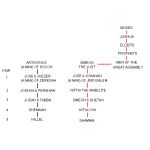
The way in which the law was handed down from pair to pair, from man to man, is illustrated by figure 1 which shows the people and the relationship between them. It also illustrates the meaning of the whole sequence.
Now let us take the matter further by looking at what we are told about the people concerned. Let us look at what their names and sayings tell us about them and of the sides they represent. The Mishnah does not waste words and much is put across in a few terse sentences.
Simeon the Just said that the world was based on the Torah, divine service and the practice of kindness. He believed that the freedom and protection the law provides is essential, that the world is based on it. The world depends on the law, on it being observed and thus applied, and on the practice of kindness. This is a statement of the Jewish position.
Alexander the Great (of Macedon) conquered Israel. When he died his empire fell to pieces. Macedon was then taken over by one of his generals, called Antigonus. His dynasty included three kings called Antigonus and ruled Macedon until it became a Roman province in 168 BCE. This coincided with the Maccabean uprising.
It was from Macedon that Alexander had spread their hellenistic ideas of a way of life based on slavery, based on the exploitation of one man by another. Antigonus' dynasty and kings called Antigonus ruled Macedon until the Maccabean uprising.
The mishnah refers to Antigonus 'of Socoh'. This place is also mentioned in a passage in I Samuel.
- It was after David had been anointed by Samuel {21} that
- 'the Philistines gathered their armies to battle, and they were gathered together at Socoh, which belonged to Judah'.
The Jews were struggling against the influx of Greek ideas and against the descendants of Greeks. The Philistines of that time were the Greeks.
It was after a Jewish way of life had been established in Israel that the Greeks gathered their armies for battle. They gathered them in Macedon, sweeping outwards from there against the Persian empire and against Israel, attempting to impose their beliefs and way of life on the Jewish people.
'Antigonus of Socoh' stands for the core of that which opposes and struggles against Jewish beliefs of freedom, justice and good life for all, stands for an ideology based on oppression and slavery.
So as to leave us in no doubt about this, the mishnah clearly announces what he stands for by his saying: Do not serve for pay, serve without expecting pay. Expect only to receive an unconditional gift to which you have no claim and fear 'heaven'.
'Be afraid and serve for the crumbs you may be thrown' is clearly the opposite of Jewish law.
|
| Figure 1 PAIRS (Zugot) |
Antigonus learns from Simeon the Just. He may have taken over some of Simeon's ideas but if so then only so as to in due course weaken or replace the essence of Simeon the Just's teachings. He is setting himself up in opposition to justice and freedom.
Antigonus 'received from' Simeon the Just and the first pair received from them. Each of the next four pairs received from the previous one.
That Antigonus 'received from', that is 'learnt from' Simeon the Just does not mean that he 'followed the teachings of'. From this time onwards the unity of the transmission is broken and the law is handed down in parallel streams.
Justice and freedom are from then on under attack by an internal opposition which wishes to weaken or reverse the intent of the law, the application of the law of Moses, of the word of God, so as to be able to oppress so as to exploit. From then on we have successive pairs representing the struggle between the opposition on the one hand and the laws of freedom on the other.
Antigonus of Socoh would seem to stand for hellenisation, increasing weakening of religion, increasing oppression and exploitation of the people, would seem to stand for central authoritarian rule and establishment.
The two opposing ideologies have been defined. A foreign ideology which stands for oppression and exploitation of people but which apparently hides behind a mask of religious orthodoxy is marshalling its forces. It is camped on Jewish soil, it attempts to spread within the Jewish people. In reality it opposes those Jewish laws which safeguard independence, freedom and justice.
The First Pair
This brings us to the first of the zugot, to the first pair, namely to Jose of Zeredah and Jose of Jerusalem.
When the mishnah says that Jose of Zeredah and Jose of Jerusalem 'received from them' it does not mean that they each followed the teachings of the other two, but it means that Jose of Zeredah followed Antigonus while Jose of Jerusalem followed the teachings and tradition of the law of Moses by following the teachings of Simeon the Just.
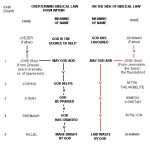
The arrangement and content of the mishnahs also make the point. There are two mishnahs for each pair. The first lists both men and this is followed by the saying of the first of them. The second mishnah gives the saying of the second of the pair. In the case of Hillel there are an extra two sayings but this does not alter the argument. The arrangement implies that the first of the pair has something in common with both streams while the second of the pair takes his ideas of law and justice straight in line from Simeon the Just. Figure 2 illustrates this point.
The message is once again driven home by the place names. The place names in the first pair tell their own story. Jerusalem on the one hand is opposed by Zeredah on the other.
Jerusalem is the 'basis', the 'foundation'. Zeredah is a place of 'anxiety', that is a place where people are oppressed.
Here a native of Zeredah starts a sequence which aimed to overturn Jewish law, which was followed by the destruction of Jerusalem and of the second Temple and the dispersion and persecution of the people.
Only one other native of Zeredah is mentioned in the whole of the scriptures. It was Jeroboam of Zeredah who took ten of the twelve tribes away from king Solomon's son after the death of king Solomon This division of Solomon's kingdom turned Jews against Jews. Immediately Jeroboam had established his authority over the ten tribes he modified Jewish worship. He also made {22} two calves of gold for the tribes to worship saying to them 'Behold the gods which brought you out of Egypt'.
He divided the people against each other and turned them against God the moment he succeeded in gaining control. The mishnah is saying repeatedly that this is what the followers of Antigonus are aiming to do.
Meaning of the Sequence
The names tell us what happened, tell the whole sequence of events and this is illustrated by figure 2.
Jose is the aramaic form of Joseph meaning 'may God add'. The two sides confront each other, each praying to their 'god' for greater numbers and strength.
The Jewish side is centred on Jerusalem. Judaism is a way of life, strengthens people, is the source of freedom and good life. It had been established, 'God has favoured' it.
The subverting antisocial ideology which wishes to put the clock back to exploitation of man by man is driven by its own 'god', its own source of strength. It is helped, it gains strength and praises its god, it gets the upper hand (god has granted).
Then it takes over, it is 'made bright'. It overturns the law from within, Jewish law and freedom are 'laid waste'.
What we have seen is the ruling establishment taking over and altering religious precepts so that the religion becomes the servant of the establishment (government or state) instead of serving God and people, resulting in oppression, exploitation and desolation and destruction.
|
| Figure 2 NAMES OF THE PAIRS |
What we have been told is how the religion was weakened from within, what was behind it and who did it. The whole sequence defines Hillel's position: He represents that which at that time weakened and overturned the intent and meaning of Jewish law.
The same sequence is used again elsewhere in the mishnah {23}. Its intended meaning is now much clearer.
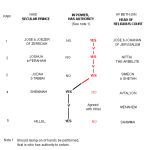
Only the five pairs are listed. This list is identical to the one we have discussed apart from the addition of one person. But here we are told that the former (of each pair) were princes (Nasi) and the latter were heads of the court (Av Beth Din).
We are also told that there was a difference of opinion between the members of each pair concerning whether 'the laying on of hands' may or may not be performed. In the first three pairs it is the Av Beth Din who says that the laying on of hands may be performed but in the next two pairs it is the Nasi who says so.
Introduced opposite Hillel is Menahem who agrees with Hillel's point of view. Menahem is followed by Shammai.
It has never been satisfactorily explained why the laying on of hands should be such an important matter or why successive pairs should disagree about this matter over five generations. According to Maimonides the laying on of hands refers to 'the ordination of elders' but it is perhaps more likely to refer to the ordination of the religious hierarchy.
If the laying on of hands means the ordination of elders or say rabbis then those who say that it may be performed are those who have the authority (power) to do so. It is they who are ordaining elders or rabbis and who are thus gaining influence. Those who say it may not be performed do not have the authority (power) to ordain elders or rabbis, are not doing so and are losing what influence they have.
On that basis the authority rested with the Beth Din and thus with the Av Beth Din for three pairs. In the last two pairs it is the Nasi who has the authority, who has the power, who decides.
The sequence is illustrated by figure 3. It is in complete agreement with the story told by the names of the pairs.
There are considerable differences of opinion about what the terms Nasi and Av Beth Din mean. I have seen Nasi referred to as President of Palestinian Community and also as elected Head of Sanhedrin. I have seen the Av Beth Din referred to as Head of Sanhedrin and also as second to the Nasi.
However, we now have a much clearer picture. What we see is that the word Nasi (prince) stands for the ruler and his establishment. It is they who wish to oppress so as to exploit. They are prevented from doing so by Jewish law and negated it and/or bypassed the protection it offered the people.
|
| Figure 3 LAYING-ON OF HANDS |
In addition we are here told that Menahem agreed with Hillel and that when Menahem 'went forth' Shammai 'entered'. The name Menahem means 'consoler' or 'comforter'.
Authority had passed from the head of the court to the prince. The head of the court was completely subservient to the prince, that is served the prince. He comforted or consoled, that is tranquillised, the people.
Menahem was followed by Shammai. The law had been turned upside down, had been 'laid waste'.
Looked at together with the other names, it confirms the story, it tells us another aspect of what happened. The religious dignitaries served the secular rulers first and foremost. The essence of the law was overturned and the religion (Jewish law) is used to tranquillise the people instead of protecting them from oppression and exploitation.
The mishnah clearly shows that Jewish law and the people are opposed by the rulers and their establishment. Wishing to exploit the people they wish to eliminate those provisions of the law which protect the people, that is wish to alter the basic constitution, the Torah. We have seen the mishnah tell us that they succeeded in introducing their antisocial ideas into Judaism and that it was done at the time of Hillel. It is Hillel who represents that which weakened and overturned the intent and meaning of Jewish law.
We saw earlier that when Hillel instituted the Prosbul he bypassed an essential protection of the people. Now we know much more about Hillel and his time. We can see why he did it, who benefited and whom he really served.
And now we can go on to explore what else he instituted and what the mishnah tells us to do in the circumstances.
HILLEL'S ORDINANCES
We have already come a long way together and now have a much better understanding of what happened to the Jewish religion at about the time of Hillel and also a better understanding of what Hillel represents. The different pieces of the puzzle fit together. Once Hillel's position has been understood it is seen that the mishnah makes the point again and again.
An ideology opposed to Jewish law, hiding behind a mask of religious orthodoxy, succeeded in weakening the application of the law. The message of the mishnah is that it was Hillel who represents this opposing ideology, that he represents the rich, the establishment and those who wish to exploit others, that it was Hillel who overturned much which is central and essential in Jewish law.
Take the case of Hillel's ordinances. There are apparently only two ordinances recorded in the mishnah as due to Hillel. The first is the Prosbul, the second concerns the redemption of town houses. These changes of the law are far-reaching and of great importance, and this applies particularly to the Prosbul.
The owner of a town house could sell it but was entitled {24} to buy it back from the buyer at any time during the first year. If he did not buy it back then the sale was legally binding and permanent.
Apparently the buyer used to hide himself on the last day of the year. This prevented the owner from returning the money, that is from buying it back from the buyer, so that the house became the buyer's permanent property.
Here Hillel ruled {25} that it was sufficient for the owner to deposit the money in a chamber. He was then entitled to break down the door of the house and occupy it while the buyer could collect the money whenever he wanted.
Here Hillel ruled to strengthen the law of the Torah against those who had found a way of bypassing its application. The buyer wants to keep the house but Hillel ruled in favour of strict application of the law, in favour of the original property owner.
In the case of the Prosbul we saw that Hillel ruled so as to weaken the law by instituting a way of bypassing its application.
It is those in need who had to borrow to survive and in the case of the Prosbul Hillel ruled in favour of the rich.
In the first case he ruled to strengthen the application of the law, in the second he ruled to weaken it. What both cases have in common is that Hillel ruled in favour of the established property owner, in favour of the rich.
There can be no doubt about what Hillel stood for, about which side he is intended to represent. In the confrontation between slave- owners and God, Hillel serves and legislates for the slave-owners, the rich, the establishment, those who wish to exploit others.
But there are no dissenting opinions recorded in the mishnah, there is no protest by Shammai.
CONTROVERSIES BETWEEN HILLEL AND SHAMMAI
Now here is something quite remarkable. In the whole of the mishnah there are recorded only three controversies between Hillel and Shammai themselves. Almost forgotten, seldom quoted, they can be found right at the beginning of the volume called Eduyot {26}, in the first three mishnahs.
Eduyot is one of the earliest of the tractates of the Talmud. It was probably put together at least in some preliminary way shortly after the destruction of the second Temple. Indeed it may well be the earliest of the tractates of the Talmud. The tractate 'Abot' also seems to be one of the earlier tractates and it contains the information about the pairs {27}.
These two tractates, Eduyot and Abot, are located {28} side by side in the same volume of the Talmud and consist only of mishnahs without gemara {29}. It is the first few mishnahs in each of these tractates which tell us about Hillel and Shammai and about the confrontation between them.
Now looking in more detail at what Eduyot tells us about Hillel and Shammai, we find them described in a very remarkable and unique way. They are called 'Fathers of the world' {30}.
The patriarchs have been referred to {31} as 'fathers' but the term 'Fathers of the world' would seem to have a more general, more fundamental, more all-embracing significance. Particularly so as the term has not been applied to anyone else and has not been used elsewhere in the mishnah.
As it was God who created the world the term 'Fathers of the world' cannot relate to the creation of the world.
Hillel and Shammai are opposed to each other, are intended to represent opposites, put forward opposing points of view. It would seem that the two sides they represent are the basic fundamental powers struggling against each other. The state of the world depends on the balance between them and it is for this reason that Hillel and Shammai are called 'Fathers of the world'.
The Torah defines both sides in a number of different but completely consistent ways:
            'gods' of Egypt,             God
            'other gods'
            Oppression and slavery       Freedom and independence
            Amalek                       Jewish people
            Hillel                       Shammai
While the Torah clearly defines the two sides and is on the side of freedom and the people, it is the Talmud which tells us about Hillel and Shammai and about which side they represent.
Once again the stage has been set, the two sides have been defined.
Now let us look at what the mishnah tells us about the controversies between Hillel and Shammai, looking in some {32} detail at the first three mishnahs.
Each of these mishnahs contains a different controversy between Hillel and Shammai. Bearing in mind that these are the only three controversies between them recorded in the Talmud, what is unexpected but immediately apparent is that they do not seem to be of breathtaking importance. They are not matters of life and death. The three disputes are unconnected with each other, are unconnected with the main theme and message of the Torah.
But let us look at this in a different way. What these three controversies have in common is that they are unconnected with each other and with the main theme and message of the Torah. This is so because they were chosen like this so that they would not be censored, so that they would remain unaltered, so that the message could be preserved and passed on unaltered to future generations. The subject matter of the disputes is immaterial to the message.
We can now look in more detail at the message in the first three mishnahs.
One point stands out straight away. These are the only three recorded controversies between Hillel and Shammai and in each case the 'Sages' say that neither of them is right, that the law is different. This is far removed from the often repeated statement that the law is according to Beth Hillel which, however, is based on later statements in the gemara which cannot overrule a mishnah. What these first three mishnahs have in common is that after Hillel and Shammai state the law as they see it we find '... but the Sages say: neither according to the opinion of the one nor according to the opinion of the other, but ...'. (See figure 4).
Hillel and Shammai state their 'opinion' but the 'Sages' differ.
It seems significant that in the first two mishnahs it is Shammai who states his opinion first while it is Hillel who differs, while in the third mishnah Hillel states his opinion first with Shammai then contradicting Hillel. I put it to you that this signifies a change in the relative positions of the two, that this signifies a change in authority. It is he who is in authority who speaks first to state his opinion. It is the opposition which contradicts.
The story would seem to be rather similar to that recorded in the sequences about the zugot. What we see is a transfer of authority from Shammai to Hillel together with some indication of what took place.
In the first mishnah, the 'Sages' state the law as being according to a position which has moved a little from Shammai's towards Hillel's position, that is Hillel's point of view has gained some following.
In the second mishnah the authority is still with Shammai but the Sages state the law as being half-way between the opinions of Hillel and Shammai. This would seem to indicate Hillel's following and authority at that point of time.
The same mishnah states that the ruling was revised after the measures had been increased. The Sages then stated that 'five are liable', but that R. Jose {33} said 'Five are exempt, five and more are liable'.
A footnote in the Soncino Talmud points out that the measures changed at Sepphoris. As far as I can make out, what happened was that Vespasian together with his son Titus set out to subdue Palestine. Sepphoris anticipated an attack by spontaneously surrendering and it was by way of Sepphoris that Vespasian penetrated the region. The Jewish members of the municipality were apparently replaced by gentiles. It was this war which resulted in the destruction of Jerusalem and of the second Temple (66-70 CE).
It seems that the Jewish religious establishment simply allowed Hillel's point of view to take over (spontaneous surrender to the Romans).
The Sages stated the law very clearly saying that a certain law applies to a quantity of five or more. But here now appears R. Jose who contradicts the Sages by saying that five are exempt, five and more are liable. What he is saying muddles the law up, gives rise to dispute and controversy since he is saying that five are both exempt and liable.
The result is illustrated by the third mishnah. Hillel is in authority and states his opinion first while Shammai contradicts. The Sages, however, again disagree with both Hillel and Shammai but in this case do not state any ruling whatsoever.
We are given an indication of their reasons in the odd measures Hillel and Shammai use. Hillel used the 'hin', a measure which was apparently derived from the Egyptian {34}, and the mishnah states that he used it because 'a man must speak in the language of his teacher'. Shammai talks in terms of a dry measure (kab) for measuring a liquid. On this basis it seems that Hillel when in authority acts for the oppressing and exploiting rulers while Shammai is making mistakes. Here the Sages do not agree with nor do they support either the one or the other.
However when 'two weavers' from the 'dung-gate' in Jerusalem state a different quantity using a different measure 'in the name of Shemaiah and Avtalyon' then the Sages confirm their statement.
However, the unit 'log' used by the two weavers appears to have been used only in the Torah for measuring or stating oil in connection with the temple offering for the cleansing {35} from leprosy.
Shemaiah and Avtalyon were the pair which preceded Hillel and Shammai. Hence this part of the mishnah seems to indicate that when the people reverse the trend and state the law in accordance with the Torah's intent that the Sages agree with them and the law regains its authority based on the power of the people.
Fig. 4 CONTROVERSIES BETWEEN HILLEL AND SHAMMAI
| MISHNAH | IN AUTHORITY | OPPOSING | THE LAW ACCORDING TO THE 'SAGES' | OTHER POINTS MADE BY THE MISHNAH | ||||||
| 1 | Shammai | Hillel | Has moved a little from Shammai's towards Hillel's position | |||||||
| 2 | Shammai | Hillel | Half-way between the opinions of Shammai and Hillel | Unconditional surrender to 'Romans' (Balance then moves to favour Hillel who has gained a slight majority and authority passes to Hillel) | Appearance of scholar R. Jose who confuses the law | |||||
| 3 | Hillel | Shammai | Do not make any ruling | Hillel supports the oppressing and exploiting rulers, Shammai makes mistakes, and the sages do not agree with either | When the people reverse the trend and state the law in accordance with its intent then the law regains its authority based on the power of the people | |||||
SERVING THE ESTABLISHMENT
We have seen that the mishnah tells us much about Hillel, tells us something quite fundamental. Two sides are facing each other. One of these is represented by Hillel and it is this which infiltrated Jewish thought and religious belief and succeeded in bypassing some of the law's essential provisions.
Up to now we have looked at what the mishnah says. However, the gemara is in some ways less formal, further away from the events, contains discussion between differing viewpoints and stories and in this way may be more descriptive and may indeed tell us more about what happened at the time.
- We are told {36} that it was related about Hillel that:
- He hired for a certain poor man who was of good family a horse to ride upon and a servant to run before him. On one occasion he could not find a servant to run before him, so he himself ran before him for three miles.
This story is used in the gemara in connection with a quotation from the Torah {37} to make the point that the community should help those in need. This is interpreted to mean that while on the one hand one should not give to the extent that the poor become rich, the rich should be maintained at the level of luxurious living to which they are accustomed.
The gemara arrives at this conclusion by quoting the Torah {37} and interpreting it by saying that 'sufficient for his need' means that one needs to maintain him but does not make him rich while 'in that which he wants' can be interpreted to mean even a horse to ride on and a servant to run before him if that is what he has been used to, since that is what Hillel did.
The story of Hillel producing for an impoverished gentleman a horse and a servant and then himself taking the place of the servant and running before the gentleman is, in my opinion, too far-fetched to be taken at its face value.
It would seem highly unlikely that the community's money would have been used to provide luxury items like a horse and a servant for a poor member of the establishment as a matter of public charity <5>. But then the poor can be taxed and can be taxed heavily.
It is a discussion about an isolated sentence from the Torah without regard to the context or the intent of the text. To understand the meaning and intent of the text, one needs to look at the previous verse and indeed also at the following three. These few verses are an impassioned plea to provide for the poor and to look after their needs. It concludes with the commandment to 'open your hand unto your poor and needy brother'.
I would interpret the statement that one should 'lend him sufficient for his need in that which he wants' by saying that the word 'wants' may well mean 'lacks' and may well refer to a need of which the impoverished may not be aware of. When one is starving one looks for food but there may be much else which is badly needed.
The story relates how Hillel provides for the establishment, provides a servant for them and serves them himself. The community's money comes from all and what Hillel did was to take away from the community so as to give to the establishment. In other words, the community became the servant of the establishment and this is the point of the story.
The intent and clear meaning of the law is to protect the poor from need and thus to protect them from exploitation. What Hillel did was to turn the law upside down. The gemara argues that the community, the bulk of the people, can according to Hillel be exploited so as to maintain and keep the rich in the style to which they are accustomed.
The gemara says so very forcefully by referring to the particular verses I have already mentioned. It is in this impassioned plea and commandment to help the poor that we find the statement to give even when the Year of Release (shemittah) approaches. It is this which was bypassed by Hillel's Prosbul. It was this Prosbul which bypassed an essential protection for the people and in so doing laid them open to oppression and exploitation. It was in this way that Hillel made the people serve the establishment and so provided the establishment with their horses and servants.
TEACHING THE TORAH
- The gemara also tells {38} that when a certain person asked Shammai to make him a proselyte 'on condition that you teach me the whole Torah while I stand on one foot', Shammai refused to do so. But when this person asked Hillel, he was told by Hillel
- What is hateful to you, do not to your neighbour; that is the whole Torah, while the rest is the commentary thereon; go and learn it.
Hillel is using two negatives (do not to your neighbour what you do not like) and this is not a valid way of making meaningful or positive statements.
There are both positive and negative commandments, there are positive and negative parts of the law. The positive statements tell one what has to be done to achieve a good life and secure future. The negative laws protect society, protect individuals from being harmed by others.
Hillel has not only left out the positive commandments but also has put the personal feelings of an individual above the essential provisions which protect society, has placed the individual's opinion above the word of God.
Hillel's statement puts the individual's likes and dislikes above the law and we know that people can be brainwashed into liking and pursuing behaviour which produces pleasure and profit to themselves at someone else's expense, at the cost of injuring those to whom it is being done. His statement would allow a sexual pervert to spread his perversion, would allow someone who is doing harm to himself by the way in which he is behaving (without perhaps being aware of it) to behave in a similarly harmful way towards other people.
What one does and does not do is not determined only by personal feeling and choice but is laid down and limited by the law of God, of the Torah. Shammai refused to teach the Torah under the stipulated conditions because the law in itself is a matter more important than the length of time a person who is not a Jew can stand on one foot.
- The statement attributed to Hillel bears a certain resemblance to the following quotation from the Torah {39}
- You shall not take vengeance, nor bear any grudge against the children of your people, but you shall love your neighbour as yourself: I am the Lord. You shall keep My statutes.
It is not just the middle part of this statement which Hillel reversed. Our attention is being directed towards the context in which that which he reversed appears in the Torah. He also legislated against the people in favour of the rulers and served the rulers instead of God, failing to keep God's statutes.
What we have seen is that Hillel served the rulers and those who supported the rulers. We saw that it was done by subtly misrepresenting the Torah so that it was applied in a way which weakened its application, so that it was applied in a way which served the establishment instead of protecting and serving the people, instead of serving God.
So now we know about Hillel and what he stood for, we have had an indication of what was done and of the methods used to do it. But the gemara tells us much more so that there can be no doubt left about what went on, about how in those days the application of the law was turned upside down.
Hence now we take a closer look at what else the gemara tells us about how Hillel came to be 'appointed'. We want to find out what happened so as to ensure that it does not happen again.
HILLEL'S 'APPOINTMENT'
The mishnah described how the 'deeply orthodox' Hillel gained a following. It points its accusing finger at Hillel, at our own establishment. How come we ever allowed ourselves to be so blinded by our establishment?
The gemara tells us much the same.
There is a long and involved mishnah which states and discusses the rules for what may and may not be done on the Sabbath when preparing the Passover offering. The gemara states that on {40} one occasion the 'Bene Bathyra' had forgotten these rules and did not know whether the preparatory work could be carried out on the Sabbath. Inquiring whether anyone knew, they were told that a man who had just come up from Babylonia and who was called 'Hillel the Babylonian' had served 'the two greatest men of the generation' and that he would know. So they summoned him and asked him. He answered them by means of two abstract logical arguments. 'They immediately set him at their head and appointed him Nasi (prince) over them'.
He then lectured them the whole day on the laws of Passover, on the laws of the festival which celebrates the freeing of the Jews from slavery in Egypt. He told them that it was because they {40} 'did not serve the two greatest men of the time, Shemaiah and Avtalyon', that he came up from Babylonia to be prince over them.
The story relates how Hillel gained control and became prince:
- He was taught by Shemaiah and Avtalyon,
- he took over from the Bene Bathyra, having
- persuaded them to hand over by means of hermeneutic rules for interpreting the law.
So what we shall do now is to look at each of these three aspects in turn. Let us begin with Shemaiah and Avtalyon. What does the gemara tell us about them?
(1) Shemaiah and Avtalyon
The first thing which strikes one is that the gemara does not see Shemaiah and Avtalyon as representing opposite sides. This fully agrees with the meaning of the mishnah about the zugot (see figures 2 and 3). It is appreciated that Shemaiah and Avtalyon do not really differ, that they represent the same side, that authority has passed to the rulers and their establishment, that what is being attempted is a process of brainwashing the population into blindly following the establishment's upside down version of Jewish law. The gemara understandably is very bitter about it.
(1a) The Two Sides
This story is straightforward and tells much.
All the people followed the high priest who stood {41} for God and Torah.
Shemaiah and Avtalyon were descended from heathens. When the people saw them they forsook the high priest and followed them.
In due course Shemaiah and Avtalyon visited him to make the point that many people support them, that they will now 'take leave of the high priest', that is go their own way and take over.
He to them: May the descendants of the heathen come in peace!
They to him: May the descendants of the heathen, who do the work of Aaron, arrive in peace, but the descendant of Aaron, who does not do the work of Aaron, he shall not come in peace!
Shemaiah and Avtalyon are doing the work of Aaron. The high priest who is descended from Aaron does not do the work of Aaron.
Scripture tells us {42} that 'Moses saw that the people were broken loose - for Aaron had let them loose for a derision among their enemies'. In other words, Moses knew that it was Aaron, the religious establishment, who had permitted the people to break loose from Jewish law, who had allowed them to follow the golden calf of the establishment.
Shemaiah and Avtalyon say that they are doing the work of Aaron, meaning by this that they are leading the people away from Jewish beliefs and towards following the establishment's views.
The high priest is on the side of Torah, does not do what Aaron did, does not betray people and God.
The two sides are once again defined. Shemaiah and Avtalyon are clearly represented as the enemy within the Jewish people, as the secular establishment and as that part of the religious establishment which serves the secular establishment.
It is they who are attempting to overturn the Torah's social laws, doing so from within the Jewish people.
(1b) Identities and Purpose
The gemara links Shemaiah and Avtalyon with some other people and tells us that both were descended from Sennacherib {43} as follows:
- Naaman was a resident alien.
- Nebuzaradan was a righteous proselyte,
- the descendants of Sisera studied Torah in Jerusalem;
- the descendants of Sennacherib taught Torah to the multitude; who were these? - Shemaiah and Avtalyon.
- The descendants of Haman studied Torah at Bene Berak.
It is heart-warming to see such devotion to the law, to see such famous people spending their lives in the service of God. But take a second look. Remember it was written during times of greatest distress and persecution. The real message is very different.
'Naaman was a resident alien'. It all depends what you mean by 'resident alien'. But I suppose it doesn't matter how you translate the Hebrew word, it doesn't matter whether you call him resident alien or foreign settler or what have you. Naaman commanded the forces of the king of Aram. It was Naaman who {44} commanded the forces which defeated the king of Israel. To call the foreign conqueror a resident alien is quite an understatement but makes the point very effectively as long as you understand the language.
'Nebuzaradan was a righteous proselyte', and this means that he was 'one who accepts all the laws of Judaism with no ulterior motive'. Nebuzaradan was captain of the guard of Nebuchadnezzar, king of Babylon. He commanded the forces which burnt down Jerusalem and destroyed the first Temple. The people were killed or enslaved and carried off to Babylon, only the poorest were left behind to serve as unskilled labourers. The Temple treasures were also taken to Babylon. That was the end of the kingdom of Judah and of the first Temple {45}. Nebuzaradan is here called a righteous proselyte: In fact it was he who destroyed the Temple.
Sisera commanded the forces of Jabin, king of Canaan {46}. We read that 'the descendants of Sisera studied Torah in Jerusalem': For twenty years he harshly oppressed the children of Israel although he was defeated in the end.
The descendants of Sennacherib, namely Shemaiah and Avtalyon, taught Torah to the mass of the people.
All of those mentioned so far commanded those who attacked the Jewish people so as to destroy them. Haman also wanted to destroy the Jewish people and in this way destroy the religion, the practice and application of Jewish law in everyday life. We are being very pointedly told that Shemaiah and Avtalyon are like the others, that they are attacking Judaism and the Jewish people. They spread their poison from within, taught their kind of law 'to the multitude', spread dissension within the Jewish people from the inside.
- Sennacherib was king of Assyria (including Babylonia) from 705 to 681 BCE. He attempted to take Jerusalem with his Assyrian army but failed. The biblical story is that he defeated Judah and exacted a heavy tribute from Hezekiah, but that he was defeated by an act of God and returned to Nineveh. Scripture tells us that {47}
- So Sennacherib, King of Assyria, departed, and went and returned, and dwelt at Nineveh. And it came to pass, as he was worshipping in the house of Nisroch his god, that Adrammelech and Sarezer his sons smote him with the sword; and they escaped into the land of Ararat. And Esarhaddon his son reigned in his stead.
The siege took place in 701 BCE, Jerusalem was not captured and Hezekiah sent his submission tribute to the king of Assyria in Nineveh. It seems that Sennacherib's son Esarhaddon succeeded to the throne about eight years after Sennacherib's death. The land where the Jews landed after the deluge, when they founded a new community after the destruction of Judah, was Babylon. It seems that Adrammelech and Sarezer escaped to Babylon.
What I have said so far is taken largely from scripture. Sennacherib's unsuccessful siege of Jerusalem is apparently known also from the Assyrian accounts. Assyrian sources, as far as I know, tell of a revolt against Sennacherib and of his murder but it is not known whether there was only one murderer or more murderers or whether they were sons of Sennacherib. Esarhaddon seems to have had a struggle with his elder brothers but the assassination of Sennacherib is not mentioned in his annals. Assyrian records do not mention a son of Sennacherib called Adrammelech and the name is unknown as an Assyrian personal name.
However, the stories in the gemara need to be looked at in the light of knowledge known or supposed at the time. They are likely to be based on contemporary writings and their meaning and message fairly clear at the time.
- This is what we are told {48}:
- On his return to Assyria, Sennacherib found a plank, which he worshipped as an idol, because it was part of the ark which had saved Noah from the deluge. He vowed that he would sacrifice his sons to this idol if he prospered in his next ventures. But his sons heard his vows and they killed their father, and fled to Kardu, where they released the Jewish captives confined there in great numbers. With these they marched to Jerusalem, and became proselytes there. The famous scholars Shemaiah and Avtalyon were the descendants of these two sons of Sennacherib.
Of course this sounds quite improbable. You might call it an old wives' tale. But old wives' tales are records of tradition with a kernel of truth which remains misunderstood until modern science catches up. This story needs to be regarded from the point of view of those living at the time.
Remember also that here they were undoubtedly trying to say something of considerable importance in a way which could be understood by themselves but not by the ruling power and which could not be held against them by their own establishment.
There is indeed quite a parallel between what happened to the descendants of Sennacherib and to Assyria when compared with what the story tells. We have a good amount of information about what happened {49}.
We are told that the Assyrian king found a plank, which he worshipped as an idol, because it was part of the ark which had saved Noah from the deluge.
This describes in religious language what Esarhaddon did in fact. He had succeeded to the throne and was determined to prevent his sons from struggling with each other for power, he was determined to prevent civil war. He arranged matters accordingly and the empire's subject rulers had to agree to abide by this Pax Assyriaca. When he died his two sons ruled side by side for l7 years. Ashurbanipal from Nineveh and Shamash-Shum-Ukim from Babylon.
In Noah's ark the animals came in two by two, there was peace between the different animals. The 'plank' found to save them from destruction was the peace treaty which prevented the struggle for power between the two brothers. It was worshipped by the king 'as an idol' which tells that he forced his subject rulers to obey and follow it, to adhere to its provisions.
He vowed that he would sacrifice his sons to this idol if he prospered in his next ventures.
This tells that if successful and thus having an empire to leave them then his two sons would be sacrificed to this idol, to the idea of peace in the realm. Neither would have complete power but there would be peace.
His sons heard his vows and they killed their father, and fled to Kardu.
In the year 652 BCE war broke out between the two brothers. After some years of bloody warfare the one in Nineveh emerged victorious. But the throne of Babylonia was seized by Nabopolassar who established the Chaldean dynasty in Babylon, successfully defended Babylonia's newly-won independence and finally eliminated and took over Assyria itself. Power and control had moved to Babylon.
It so happens that Babylonia had been called {50} Kar-duniash sometime before. 'Kardu' clearly refers to Babylon.
The sons didn't abide by their father's peace treaty, and killed the father, which means that in breaking the peace, in warring with each other, they destroyed Assyria and destroyed their father's dynasty. They fled to Kardu which denotes the passing of power from Nineveh (Assyria) to Babylon and this is in full agreement with the biblical version I mentioned earlier.
In Kardu (Babylon) they released the Jewish captives confined there in great numbers. With these they marched to Jerusalem, and became proselytes there.
The mentioning of 'Jewish captives' confirms that Kardu stands for Babylon. But it so happens that Nabopolassar's son was Nebuchadnezzar who succeeded to the throne of Babylon and conquered Jerusalem and Judah, who destroyed the first Temple with brutal destruction of the people and exile to Babylon. The Babylonians must certainly have marched to Jerusalem in considerable numbers. This is what the story tells us. 'Becoming proselytes' refers to the destruction of the Temple in Jerusalem and the vicious brutal slaughter and enslavement of the population.
The statement that Shemaiah and Avtalyon descended from those who led their people in battle against the Jewish people and who destroyed the Temple, Jerusalem and Judah, bearing in mind that what is indicated is that they 'descended from them' meaning 'followed their ideas, had the same intentions', is a very grim accusation indeed.
When the gemara {51} talks about a certain man 'who has come up from Babylonia, Hillel the Babylonian by name, who served the two greatest men of the time, ...' then the references to Hillel as having come from Babylonia and being called 'the Babylonian', as having served Shemaiah and Avtalyon take on a far more sinister meaning than has been supposed so far.
The descendants of Haman studied Torah in Bene Berak. Haman 'the Agagite' is presumably called this to indicate descent from Agag the king of the Amalekites {52}. Scripture tells how he set about to exterminate all the Jews in Persia. It also tells how his plans backfired. Haman was he who led this attack on the Jews. It seems that his descendants studied Torah in Bene Berak but this I will discuss in more detail later.
The term 'descendants' appears to be used so as to indicate those who followed the ideas, who had the same purpose as those whom they followed and Naaman, Nebuzaradan, Sisera, Sennacherib and Haman were all powerful enemies of the Jews, had all tried to destroy the people, had succeeded or failed in varying degrees. The sum total of the harm actually done or intended by those here mentioned is almost unimaginable. To see Shemaiah and Avtalyon mentioned in such company confirms all that we have said about them and tells much more.
What is absolutely staggering is that such heartfelt protest against the actions of the secular and religious leadership should have been kept hidden for so long.
We have seen who Shemaiah and Avtalyon were, whom they represent, and what is said about them. None of it is pleasant, it is all pretty horrifying.
(2) Bene Bathyra
We are told by the gemara that the Bene Bathyra listened to Hillel's abstract arguments and immediately set him at their head and appointed him 'Prince' over them.
He immediately told them that he ruled over them because he had served Shemaiah and Avtalyon, while they had dared not to serve them. This would seem to make the point that the Bene Bathyra were on the side of Torah and people.
The gemara does not tell us who the Bene Bathyra were. This may have been common knowledge when the gemara was written but it has been lost.
However, just who the Bene Bathyra were, is in fact obvious. The hebrew 'bene bathyra' states that they are the children or sons of the Covenant, of those who carry out the brit. The Bene Bathyra are those who follow the word of God, who adhere to the laws of the Torah including its social laws and its social system.
(3) Bible Interpretation
The Bene Bathyra allowed abstract rules <6> of bible interpretation to confuse the law and handed over their authority.
We have already seen that a religious establishment which served the secular establishment gained control. They took over from a religious establishment which served God and people.
We have also seen that this secular-establishment serving religious establishment abrogated the social laws and social system of the Torah, doing so by abstract, illogical and invalid arguments.
So here we are told that Jewish belief and practice now serves its establishment instead of serving God and people and that it was abstract, illogical and invalid rules of bible interpretation which had brought this about.
HERMENEUTIC RULES
'Hermeneutics' is said to be <7> a way of bringing out and explaining the meaning of the Torah by means of a number of rules of logic and association.
Hillel argued with the Bene Bathyra by means of hermeneutic rules. He was apparently the first, or one of the first, to apply such rules not just for explaining the Torah but for deriving new meaning and new laws.
It seems that Hillel introduced the application of hermeneutic rules (rules of logic and association) for determining new laws. It is from about this time that argument began amongst the scholars about the meaning of the law. It is a tannaitic tradition that the great Sanhedrin decided any matters that had to be resolved but that as the pupils of Hillel and Shammai increased so controversy increased in Israel. Suddenly there were many differences which had to be resolved <8>.
In other words, before these rules of logic and association were introduced, the law seems to have been decided according to the Torah and in line with its intent.
But the use of abstract rules of logic and association resulted in laws which were unrelated, or perhaps even outside or opposed to the meaning of the original text of the Torah, and in this way controversy increased in Israel.
- Indeed, it seems {53} that there developed two schools of interpretation:
- R. Ishmael and his academy endeavoured to uphold modes of interpretation that would maintain the legal and logical meaning of the scriptural passages concerned. R. Akiba and his academy adopted modes of interpretation that widened the meaning of the scripture far beyond the terms of the written text, even when the conclusion was not altogether in keeping with the general meaning of the verse, expounding every seemingly superfluous word or phrase and the occurrence of every synonym or repetition of a word or even letter.
There are thirteen rules and these are external teachings, that is external to the Talmud. It seems that at least some of the rules have Greek parallels {54}. However, the gemara {55} quotes one, namely 'the meaning of a passage is to be deduced from its context'.
Another rule draws conclusions from comparing similar phrases appearing in different parts of the Torah. This rule is called Gezera Shava. From the similarity of words or phrases occurring in two often unrelated passages it is inferred that what applies in the one applies also to the other. Where this rule is used to draw conclusions regardless of the context then the results are sometimes truly astonishing.
Examples of such reasoning are Hillel's arguments before the Bene Bathyra, Rabbi's arguments <9> supporting Hillel's Prosbul, R. Simeon's ruling about using flesh cooked in milk {56} and one which states {57} that the words 'release: release' refer to oaths.
What is even more astonishing is that some people can accept the end result without even observing how far removed the conclusion is from the spirit and intent of the law. How come we ever allowed ourselves to be confused in this way?
NOTES AND BIBLIOGRAPHY
NOTES
| < 1> | See
History Speaks: Monarchy, Exile and
Maccabees https://www.solhaam.org/ Manfred Davidmann |
|
| < 2> | See 'If One Lapses, So Does The Other', p.7 | |
| < 3> | Tosefta and Beraitot (Baraita) | |
| < 4> | Pentateuch | |
| < 5> | And yet this is being done on a vast scale in Israel. See 'The Way Ahead for Israel; Vol. 1: Causes of Present Problems' by David Baram | |
| < 6> | The same point is also made by the mishnah, e.g. 'Controversies between Hillel and Shammai', mishnah 2. See what happened at Sepphoris. | |
| < 7> | Sometimes the word 'exegesis' is used when referring to a commentary on scripture. The word 'interpreting' means 'bringing out and explaining the meaning of'. | |
| < 8> | The mishnah makes the same point. See 'Controversies between Hillel and Shammai', mishnah 2. See my discussion of R. Jose's version of the law. | |
| < 9> | See 'If One Lapses So Does the Other', p.7 | |
| <10> | Talmud: The Babylonian Talmud, Soncino Press, London. | |
| <11> | Laws of the Year of Freedom (yovel year) |
BIBLIOGRAPHY
- { 1} TB, Arakin 32b
- { 2} Lev 25, 10, 13
- { 3} Soncino, London, 1972
- { 4} Deut 15, 7-11
- { 5} TB, Shevi'it 10, 3
- { 6} TB, Shevi'it 10, 4
- { 7} TB, Gittin 36b
- { 8} Jerusalem Talmud: Shevi'it 10, 2
- { 9} Deut 15, 1-2
- {10} Babylonian Talmud: Gittin 36a, Moed Katan 2b, Kiddushin 38b
- {11} Kiddushin 38b
- {12} Jerusalem Talmud: Shevi'it 10, 2
- {13} Babylonian Talmud: Gittin 36a, Moed Katan 2b, Kiddushin 38b
- {14} TB, Horayoth 4b
- {15} Exod 34, 21
- {16} Dayan Grunfeld, Dietary Laws, Vol. 2, p.106 (TB: Moed Katan 2b; Gittin 36a).
- {17} Deut 4, 2
- {18} Deut 17, 8-11
- {19} TB, Gittin 34b
- {20} Aboth 1, 1-15
- {21} 1 Samuel 17, 1
- {22} 1 Kings 11, 26; 12, 20, 28
- {23} Hag 16a
- {24} Lev 25, 29-30
- {25} Arakin 31b (Kodashim 3)
- {26} Tractate
- {27} Zugot
- {28} Order 'Nezekin'
- {29} Babylonian Talmud
- {30} Eduyot 1, 4
- {31} Legends of the Jews 5, p.378
- {32} Eduyot 1, 1-3
- {33} Name means 'He shall add'
- {34} Haim Herman Cohn, Associate Professor of Law, Hebrew University,
- Ency. Judaica 16, 388
- {35} Lev 14, 10, 12, 15, 21, 24
- {36} Kethubot 67b (Nashim 2, p.410)
- {37} Deut 15, 8 (7-11)
- {38} Shab 31a
- {39} Lev 19, 18-19
- {40} Pes 65b (Moed 2, Pesahim p.333)
- {41} Yoma 71b (Moed 3, Yoma p.339)
- {42} Exod 32, 25
- {43} San 96b (Nezekin 3, p.652)
- {44} 2 Kings 5, 1
- {45} 2 Kings 25, 8-22
- {46} Judges 4, 2-3
- {47} 2 Kings 19, 35-37; Isaiah 37, 36-38; 2 Chronicles 32, 20-21
- {48} Legends of the Jews, L. Ginzberg, 4, 269
- {49} Ency Judaica, 16, 1503-,
- {50} Ency Judaica 16, 1499
- {51} Pes 66a (Moed 2, Pesahim p.334)
- {52} 1 Samuel 15, 8
- {53} Ency Judaica 8, 1417
- {54} Sanhedrin 88b (Nezekin 3, p.586)
- {55} Hul 63a
- {56} Hul 116a (p.639)
- {57} Shebuoth 49a (p.303)
Relevant Current and Associated Works
| Other relevant current and associated reports by Manfred Davidmann: | ||
| Title | Description | |
| The Meaning of Genesis: Creation, Evolution and the Origin of Evil | Shows that there is no conflict, no contradiction, no divergence, only awe-inspiring agreement, between what is recorded in Genesis and what we know about the evolution of human beings. And Genesis defines good and evil, pointing to the root of evil. | |
| Genesis: Morality, Sexual Behaviour and Depravity | Moral and immoral behaviour and unavoidable consequences. Summarises corresponding present social problems. Describes the Pentateuch's social laws and social system for achieving a good life of high quality. | |
| Genesis: Nephilim, Dominance and Liberty | Genesis on consequences of gaining and misusing power over others. Summarises corresponding present social problems. Describes the Pentateuch's social laws and social system for achieving and keeping liberty and a good life of high quality. | |
| Meaning and Significance of the Names of God in Genesis | This short report describes the meaning and significance of the names of God which are used in Genesis. These are of the greatest importance for understanding the meaning of the text of the Bible. | |
| Bible Translations, Versions, Codes and Hidden Information in Bible and Talmud | Shows how changes made in the past have obscured the original intended meaning. Describes the ways in which hidden information has been encoded and labelled so that its original meaning could not be misunderstood or misinterpreted. | |
| ORIGIN OF CHRISTIANITY and JUDAISM | Proves by methods of biblical archaeology what Jesus really taught, how Paul changed what Jesus had taught, how this became Christianity's official doctrine. Outstanding are sections on Paul and the Gospels, on concurrent corresponding changes in Judaism. | |
| Jewish Belief and Practice | Provides the required background knowledge of the essential core of Jewish belief and practice for drawing the only possible conclusion that the procedure called 'Prosbul' is contrary to the laws and intent of the Torah. The Prosbul is then annulled. | |
| Family, Sex and the Individual | This report investigates casual sex and its effects on individuals, family and community. It examines the role of the family in bringing up children and relates dominance and confrontation within the family to that in the working environment. | |
| Causes of Antisemitism | Shows that there are two separate root causes of antisemitism. One cause can be remedied by increasing peoples' awareness, the other is under the control of the Jewish people and can be remedied from within. | |
| The Right to the Land of Israel | This report proves that the right to the land in which one lives, that is the strength and success of a people, depends on how people behave towards each other. This applies to all. The history of the Jewish people provides a convincing example. | |
| Compiling the Koran: Hadiths (Traditions) State the Underlying Reality | Zaid bin Thabit compiled the Koran, Caliph Uthman had an official version prepared. Mohammed taught that people (believers) should have a good life, the ruling elite considered that people should serve willingly. | |
| Uthman's Rearrangement of the Chronological (as revealed) Koran's Chapters | Chapters (suras) marked by 'abbreviated letters' show how the sequence of the Koran's chapters was changed. The effects of the changes on the record of Mohammed's preaching and teaching are described as are the doctrines of 'Abrogation' and 'Consensus'. | |
| Prophet Mohammed's Word of Allah and the Voice of the Ruling Elite | Mohammed's social teachings are stated from chapters (suras) singled out by 'Abbreviated Letters', statements of revelation from compassionate and caring Allah. It seems that some self-seeking doctrines were added later by the ruling elite of that time. | |
| The God-given Human Rights, Social Laws and Social System | A comprehensive statement of the God-given human rights which underlie all freedom, liberty and independence. They are the foundation of the main religions of Judaism, Christianity and Islam, and they underlie and determine a good life of high quality. | |
RELEVANT SUBJECT INDEX PAGES
Other Subjects; Other Publications
The Site Overview page has links to all individual Subject Index Pages which between them list the works by Manfred Davidmann which are available on the Internet, with short descriptions and links for downloading.
To see the Site Overview page, click Overview
Copyright © Manfred Davidmann 1978, 1982, 1989, 1995, 2002, 2007
ISBN 0 85192 037 3 Second edition 1982
All rights reserved worldwide.
History
26/03/02 Added 'Overview' and 'Links to Relevant Works'.
Updated 2021 - the following links were added:
TERMS OF USE
THEME OF THE WEEK
About Manfred Davidmann and his Works
BOOKS
Donations
Privacy Notice
Contact form